
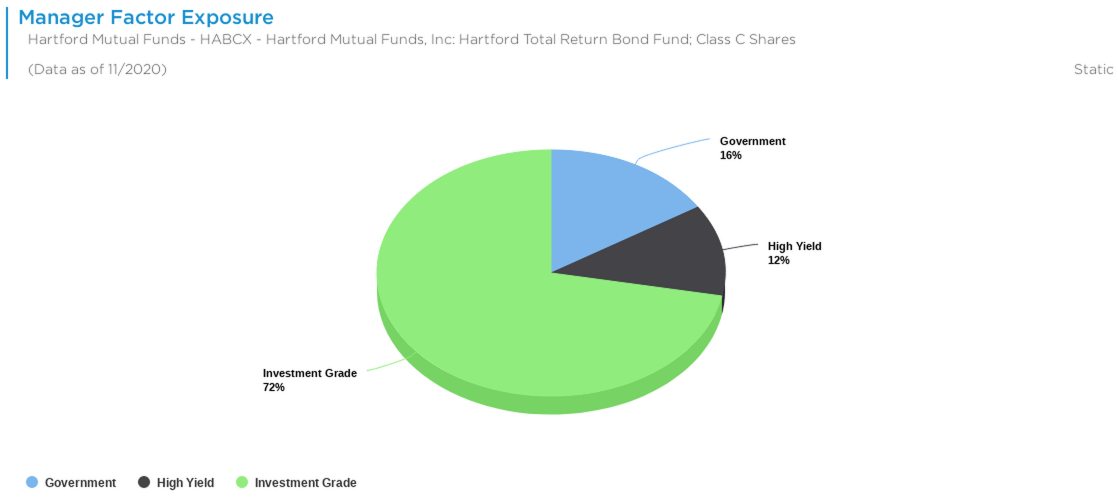
This pie chart displays the factor exposures of the selected manager product, using static (full history) or dynamic (recent 36 months) clone methodology. Toggle between factor, distinct, cap size, or region views to analyze exposures across available factors depending on the fund.
Chart Elements
- The center pie shows manager product factor breakdown by percentage (e.g., 49% Defensive green, 34% Value blue, 13% Low Volatility light blue, 4% Quality pink).
- The legend identifies factors: Defensive (green), Low Volatility (light blue), Quality (pink), Value (blue).
- The Static (full history) toggle (selected) uses inception-period average exposures.
- The Dynamic (most recent 36 months) toggle enables rolling window view.
- Distinct toggle aggregates similar factors.
- Factor toggle (selected) shows granular split.
- Cap Size and Region toggles enable size/geography breakdowns.
- Data as-of notes recency (e.g., 12/2025).
How It Works
Aapryl constructs static clones from full-history factor loadings and dynamic clones from recent 36 months. Available factors (depending on fund): Value (low P/E, P/B), Core (neither value/growth), Growth (high growth rates, P/E, P/B), Defensive (stability via low earnings variability, high ROA, low leverage), Economic Sensitivity (cyclical exposure), Momentum (high price momentum), Quality (high ROA, low leverage, earnings stability), Yield (high dividend yields), Low Volatility (lowest std. dev. or beta). Distinct combines overlaps; Factor separates.
Key Insights to Spot
Largest slice reveals primary tilt (e.g., 49% Defensive). Static vs. dynamic gap shows style evolution. Low Volatility + Quality combo signals downside protection. Value dominance vs. Growth absence flags contrarian approach. Factor availability varies by fund universe.
Actionable Uses
Match manager factors to benchmark for style consistency. Screen for mandate-aligned tilts. Probe “Your Defensive tilt vs. benchmark Growth?” in DD. Track dynamic shifts for style drift. Compare vs. peers for relative positioning.